
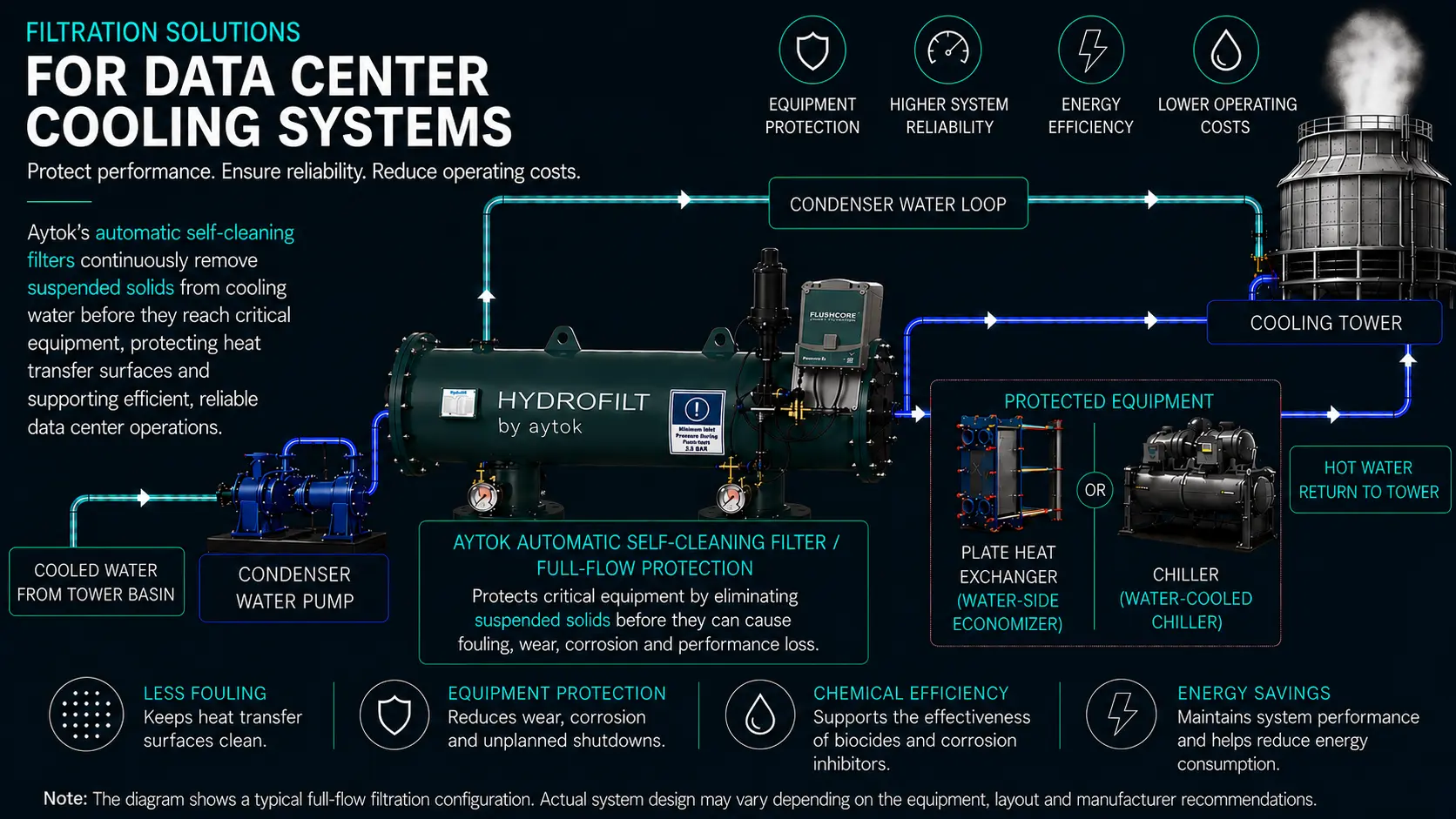
The overlooked layer of data center cooling
Modern data centers are evolving at an unprecedented pace. Driven by artificial intelligence (AI), cloud computing and hyperscale growth, today's digital infrastructure processes more data — and generates more heat — than ever before. As rack power densities continue to increase, particularly in high-density and AI deployments, cooling is no longer a supporting utility: it is mission-critical infrastructure. When cooling degrades, IT load must be curtailed or shut down.
While attention typically focuses on servers, cooling architectures and energy efficiency, the cooling water system remains one of the most important — yet most frequently overlooked — elements of the entire cooling infrastructure. In water-cooled facilities, heat is ultimately rejected through cooling towers, condenser water loops, heat exchangers, pumps and associated equipment.[1] The performance and reliability of every one of these assets depends not only on mechanical design, but on maintaining consistent cooling water quality throughout the system's life.
Unlike closed hydraulic circuits, open cooling towers are continuously exposed to their environment. Cooling towers continuously draw large volumes of ambient air through the system, allowing airborne dust, sand, pollen, organic debris and other particles to enter the circulating water during normal operation. Additional contaminants enter with make-up water, form as corrosion by-products within the loop, or result from ordinary equipment wear. Without effective particle control, this load accumulates steadily through the circuit: fouling heat transfer surfaces, restricting flow paths, accelerating equipment wear and eroding heat transfer efficiency over time.
Cooling water filtration provides a continuous mechanical method of removing suspended solids from the circulating water. In doing so, filtration protects critical cooling equipment, keeps heat transfer surfaces cleaner, limits sediment accumulation and supports long-term system reliability.
One point deserves emphasis at the outset: filtration does not replace chemical water treatment. The two perform complementary functions within a single cooling water management strategy. Chemical treatment controls corrosion, scaling and microbiological activity; filtration continuously removes suspended solids and particulate matter, complementing the role of chemical water treatment. Reducing suspended solids may support the effectiveness of the overall water treatment program, depending on water quality and operating conditions.
- Cooling water filtration continuously removes the suspended solids that degrade cooling system performance.
- Filtration complements chemical water treatment; it does not replace corrosion, scale or microbiological control programs.
- The required filtration degree should be determined according to the smallest protected passage, the particle size distribution and the equipment manufacturer's recommendations — not a generic industry figure.
- The right filtration strategy follows from water quality data, hydraulic conditions, contamination characteristics and the facility's cooling architecture.
- Automatic self-cleaning filtration is widely preferred in mission-critical facilities because cleaning is completed without interrupting flow and without manual intervention.
Why reliable cooling is critical for modern data centers
High-density data centers have very limited tolerance for cooling degradation. Even relatively short cooling interruptions can affect system availability and operational continuity, because rack inlet temperatures can increase rapidly following a loss of cooling. This places the entire heat rejection chain — towers, condenser loops, exchangers, pumps — among the facility's availability-critical systems.
Even relatively short cooling interruptions can affect system availability and operational continuity. Particle-driven fouling and blockage are preventable contributors to thermal risk.
Cooling is typically one of the largest non-IT energy consumers in a data center.[5] Fouled surfaces raise approach temperatures and increase chiller lift — converting into electrical cost long before availability is threatened.
Evaporative heat rejection consumes significant volumes of water.[4] Filtration supports the overall cooling water management strategy; consumption itself is primarily influenced by system design, climate, heat load, make-up quality and the chemical treatment program.
Why cooling water quality matters
For filtration purposes, contaminants in cooling water can broadly be divided into dissolved constituents and suspended solids. Dissolved constituents — hardness, alkalinity, chlorides, silica — drive scaling and corrosion behavior and are the domain of the chemical treatment program. Suspended solids — dust, sand, organic debris, corrosion products, microbiological floc — are physical particles that are most effectively controlled through mechanical filtration.
The suspended solids load in an open cooling system is never static. It varies with the seasons (pollen in spring, dust in dry months), with the surroundings (construction activity, agriculture, coastal sand, urban pollution), with the make-up water source, and with the condition of the loop itself. A single sample can therefore understate the design problem; the filtration system must handle the realistic peak load, not the average.
Deposits that form on condenser and heat exchanger surfaces add thermal resistance, reduce the overall heat transfer coefficient (U) and increase the energy required to deliver the same cooling duty.[1][4] Biofilm deserves particular attention in this regard: it can significantly reduce heat transfer efficiency while providing a surface for further particulate accumulation. Fouling, in short, is an energy problem before it is a cleanliness problem.
Where filtration fits within a data center cooling system
Three application points cover the practical range of data center configurations, and large facilities frequently combine them. Select a filtration point below to see how it fits into the loop.
3.1 Side-stream filtration
A side-stream system continuously draws a portion of the circulating flow, passes it through an automatic filter, and returns it to the loop. Although only a fraction of the flow is filtered at any instant, the loop volume is turned over repeatedly, progressively reducing suspended solids toward a stable, low equilibrium. Because the circuit operates in parallel with the cooling loop, it can be installed, serviced or expanded without interrupting cooling — the property that makes side-stream filtration the most commonly applied strategy for condenser water loops in continuously operating facilities.[6] The appropriate side-stream flow rate is determined by engineering assessment based on loop volume, contamination load, turnover targets and operating conditions.
3.2 Full-flow filtration
Full-flow filtration places the filter directly in the flow path, so all water reaching the protected asset passes through the filtration stage. In data center cooling systems, it is generally applied selectively rather than across the entire condenser water loop. A common example is the protection of plate heat exchangers used in water-side economizer or free-cooling service, where relatively narrow flow passages — depending on plate geometry — may be sensitive to debris. Blockage can impair heat-transfer performance and, depending on system redundancy, create an operational availability risk. Because filter size, pressure loss and capital cost scale with the full branch flow, full-flow protection is normally targeted at equipment that justifies this level of protection.
3.3 Make-up water filtration
Evaporation continuously removes water from an open cooling loop and concentrates the dissolved constituents that remain.[4] Make-up water is introduced to replace this evaporative loss and other system losses. Where the make-up source is a well, surface water or reclaimed water — and in some cases mains water — its suspended-solids profile should be evaluated before it enters the cooling system. Make-up water filtration helps reduce the entry of source-derived sediment and suspended solids into the loop, thereby lowering the particulate burden on the side-stream filtration system. The appropriate filtration technology and degree should be determined from source-water analysis and the requirements of downstream equipment.
Critical equipment protected by cooling water filtration
| Equipment | Particle sensitivity | Consequence of contamination |
|---|---|---|
| Plate heat exchangers | Relatively narrow flow passages, depending on plate geometry; among the most blockage-sensitive assets in the loop, especially in free-cooling duty. | Channel blockage, rising approach temperature, exchanger taken offline for backflushing or opening. |
| Chiller condensers | Sediment and biofilm settle on tube surfaces, adding thermal resistance. | Higher condensing temperature and compressor lift; can increase energy consumption over time. |
| Cooling towers | Spray nozzles clog; fill passages foul; basins accumulate sludge that shelters biological growth. | Uneven water distribution, reduced thermal capacity, an increased burden on the water treatment program, more frequent manual cleaning. |
| Pumps and valves | Abrasive particles erode mechanical seals, impellers and control valve trim. | Seal failures, loss of control authority, unplanned mechanical maintenance on a live loop. |
| Sensors and instrumentation | Deposits foul conductivity probes, flow meters and temperature wells. | Drifting measurements that may affect monitoring accuracy and control performance. |
Common operational challenges caused by suspended solids
Suspended solids rarely cause a sudden failure. They cause a slow, compounding drift away from design performance — rising energy cost first, availability risk second. Five failure modes account for most of the damage.
Fouling of heat transfer surfaces
Sediment layers add thermal resistance and reduce the overall heat transfer coefficient. Approach temperatures rise and the facility pays for the same cooling with more energy.
Biofilm development and microbiological risk
Sediment and organic debris provide the substrate on which biofilm anchors — and shield microorganisms from biocide contact. Removing sediment and organic debris may support the overall microbiological control program by reducing deposits that can shelter microorganisms. However, filtration is a complementary measure and not a substitute for a comprehensive Legionella water management program.[2][3]
Nozzle and channel blockage
Tower spray nozzles and plate exchanger passages are the narrowest points in the loop; debris that is harmless in a large pipe becomes a flow restriction exactly where the system can least afford one.
Abrasive wear and corrosion acceleration
Hard particles erode seals, impellers and valve trim; abraded surfaces then corrode faster, and corrosion by-products re-enter the water as new particles — a self-reinforcing cycle. Filtration helps limit the conditions that contribute to deposit formation.
Reduced chemical treatment efficiency
A high suspended solids load consumes oxidizing biocides and interferes with inhibitor films. Reducing suspended solids may support the effectiveness of the overall water treatment program, depending on water quality and operating conditions.
Choosing the right cooling water filtration strategy
- Characterize the water. Measure TSS and turbidity in the loop and the make-up source; where possible, obtain a particle size distribution and observe seasonal variation. Trend data is more valuable than any single sample.
- Identify the most sensitive asset. The required filtration degree should be determined according to the smallest protected passage, the particle size distribution and the equipment manufacturer's recommendations.
- Assign filtration points. Side-stream filtration for the loop as a whole; full-flow protection for blockage-critical branches; make-up filtration matched to the source. Large facilities usually need a combination, not a single answer.
- Size for turnover, not just flow. Loop volume and the target water quality matter as much as the circulation rate when sizing a side-stream system.
- Respect the facility's operating philosophy. Concurrent maintainability may require redundant filtration capacity or bypass provisions, so that the filtration system itself never forces an operational compromise.
Filtration systems should always be selected based on project-specific water analysis and system requirements. Generic figures — filtration degrees, side-stream ratios, cleaning set-points — are starting points for discussion, not design values.
Key design considerations before selecting a filtration system
An engineering assessment needs, at minimum, the following data. The more of these that are known, the more precisely the system can be sized — and the fewer assumptions carry risk into operation. Tap each item as you confirm it for your project.
Cooling Architecture
Water-cooled chillers with towers, water-side economizer, hybrid/adiabatic — which cycles does the loop run through the year?
Circulation Flow & Loop Volume
These set side-stream sizing and turnover rate.
Make-up Water Source
Mains, well, surface or reclaimed water? Each brings a distinct particle profile.
TSS / Turbidity Data
Measured values, ideally with seasonal trend data.
Most Sensitive Asset
Together with the particle size distribution and the equipment manufacturer's recommendations, this defines the filtration degree.
Site Environment
Construction activity, agricultural surroundings, coastal sand, urban pollen — what do the towers actually draw from the air?
Redundancy Philosophy
Does concurrent maintainability require redundant filtration or bypass arrangements?
Backwash Discharge
Where does flush water go, and do discharge permits constrain frequency or volume?
Monitoring Integration
Which signals must reach the BMS/SCADA — differential pressure, flush cycle counts, fault alarms?
Footprint & Hydraulics
Available plant room space, and whether loop pressure can drive the side-stream circuit or a booster pump is required.
Why automatic self-cleaning filtration is preferred in data centers
Continuous cooling availability is one of the defining design requirements of modern data centers. Any filtration technology that requires flow to be interrupted for cleaning — cartridges to be swapped, baskets to be emptied — introduces both a recurring maintenance burden and a human-intervention risk into a system designed to run unattended.
Automatic self-cleaning filters resolve this structurally. Cleaning is typically initiated by differential pressure and/or time-based settings configured according to the application, and completes automatically without requiring manual interruption of the cooling circuit. No consumable elements are replaced, and the filter's controller logs every cycle. The result is a monitorable, alarm-capable asset: differential pressure, flush frequency and fault states can be supervised through the BMS/SCADA with the same visibility as pumps, chillers and towers. A rising baseline differential pressure or flush count provides valuable diagnostic information — early warning of a changing contamination load from nearby construction, a failing component or a seasonal shift.
This combination — unattended operation, continuous flow, and remote visibility — is why automatic self-cleaning systems are widely preferred for mission-critical cooling loops.
Selecting the right filtration technology
The selection of a cooling water filtration technology depends on particle characteristics, water quality, hydraulic conditions and the protected equipment. There is no single "right technology"; the appropriate choice — or staged combination — follows from these project-specific factors. Filtration degrees within each technology vary by manufacturer and model, and should be confirmed against the project-specific requirement.
Surface retention, automatic cleaning
Particles are retained on a stainless steel screen; when accumulation reaches the configured cleaning set-point, a focused cleaning mechanism cleans the screen without interrupting flow. Screen filters offer high flow capacity per unit and a compact footprint — a significant advantage in space-constrained plant rooms — and are particularly well suited to predominantly inorganic loads such as atmospheric dust, sand and corrosion products, which is the typical condenser loop profile.
Condenser loop side-streams; heat exchanger protection; high flow in limited space.
Surface + depth retention
A stack of grooved polymeric discs retains particles both on the surface and within the depth of the grooves — a dual-stage mechanism that handles a broader particle spectrum than surface-only filtration, including organic particles commonly found in open cooling tower systems. Polymeric construction tolerates corrosive water chemistry, and air-assisted backwash designs keep flush water consumption low.
Mixed organic and inorganic loads; corrosive water chemistry; sites prioritizing low backwash water consumption.
Depth retention through a graded bed
Water passes through a graded bed of sand, gravel or crushed glass, and particles are retained throughout the depth of the bed. This depth-filtration mechanism is effective for fine, low-density sediment that surface technologies pass — typically the profile of surface-water or reclaimed make-up sources. Backwash water demand and footprint are the sizing trade-offs to evaluate against the required water quality.
Make-up water from surface or reclaimed sources; applications where turbidity control is the priority.
Centrifugal pre-separation
Centrifugal separation with no moving parts, no screen and no conventional filter-element backwash: dense particles are continuously ejected to an underflow while clean water exits the top. Hydrocyclones are effective for dense particles, do not retain organic or low-density material, and therefore serve as a pre-separation stage protecting a finer filter downstream — most often on sandy well-water make-up lines, where they help reduce the load reaching the fine stage.
Sandy well-water make-up lines; the first stage of a staged make-up treatment train.
| Technology | Retention mechanism | Typically selected when |
|---|---|---|
| Automatic screen filter | Surface retention on a stainless steel screen; automatic cleaning at the configured set-point. | Predominantly inorganic load (dust, sand, corrosion products); high flow in limited space; condenser loop side-streams and heat exchanger protection. |
| Automatic disc filter | Surface + depth retention in grooved polymeric disc stacks. | Mixed loads including organic particles common in open towers; corrosive water chemistry; low backwash water consumption is a priority. |
| Media filter | Depth retention through a graded bed of sand, gravel or crushed glass. | Fine, low-density sediment; surface-water or reclaimed make-up sources; turbidity control is the priority. |
| Hydrocyclone | Centrifugal separation of dense particles; no screen, no moving parts, no conventional filter-element backwash. | Sandy well-water make-up lines; as a pre-separation stage protecting a finer filter downstream. |
Real-world application: data center cooling water filtration, Johor, Malaysia
Hyperscale data center · Johor, Malaysia
Aytok Filtre supplied automatic filtration systems for a hyperscale data center project in Johor, Malaysia. With a total area of 128,000 m², the facility is among the large-scale developments in one of Southeast Asia's fastest-growing data center regions.
As a mission-critical facility operating continuously, the data center required cooling water filtration that protects the cooling infrastructure without interrupting operation. Automatic self-cleaning filtration was applied, with cleaning cycles completed automatically while maintaining continuous protection of the cooling system.
The project demonstrates the practical application of the design principles described throughout this guide: filtration selected and sized according to the facility's water conditions and operational requirements, and configured for the continuous, unattended duty that mission-critical cooling demands.
Best practices for reliable cooling water filtration
Design from water analysis, not assumptions
Base filtration degree and technology on measured TSS, particle size distribution and make-up source data — and re-verify after any change of water source.
Protect the smallest passage
Let the most sensitive asset — together with the equipment manufacturer's recommendations — define the filtration degree, not the loop average.
Coordinate with the chemical program
Align filtration commissioning and performance reviews with the water treatment provider; the two programs succeed or struggle together.
Trend differential pressure and flush frequency
A rising baseline is early warning of a changing contamination load — act on the trend, not the alarm.
Install filtration before commissioning
New loops carry construction debris; filtration in service at start-up captures this initial load instead of letting it distribute through new equipment.
Respect the redundancy philosophy
In concurrently maintainable facilities, provide bypass or redundant arrangements so filtration itself never becomes the constraint.
Review annually
Contamination profiles change — surrounding land use, water sources and loop condition all evolve. An annual review keeps the system matched to the real load.
Frequently asked questions
Does filtration replace chemical water treatment in a data center cooling system?
No. Chemical treatment controls corrosion, scaling and microbiological activity; filtration continuously removes suspended solids. They are complementary — reducing suspended solids may support the effectiveness of the overall water treatment program, depending on water quality and operating conditions.
Is side-stream filtration enough, or do we need full-flow?
For the condenser water loop as a whole, side-stream filtration is the commonly applied approach. Full-flow filtration is applied selectively to blockage-critical branches — most commonly plate heat exchangers in free-cooling service, whose relatively narrow flow passages leave little tolerance for debris. Many facilities combine both.
What filtration degree should a data center cooling loop use?
There is no universal value. The required filtration degree should be determined according to the smallest protected passage, the particle size distribution and the equipment manufacturer's recommendations — which is why water analysis precedes selection.
Why are automatic self-cleaning filters preferred over manual filters in data center cooling systems?
Manual and cartridge-type filters require flow to be interrupted and elements to be handled or replaced — a recurring maintenance burden and a human-intervention risk in a system designed to run unattended. Automatic self-cleaning filters complete their cleaning cycles automatically, without requiring manual interruption of the cooling circuit, use no consumable elements, and expose their operating signals to the BMS/SCADA. In continuously operating facilities, these properties make automatic self-cleaning filtration the widely preferred approach.
Does filtration help with Legionella risk?
Filtration is not a disinfection technology and does not remove bacteria directly. However, by removing the sediment and organic debris that shelter microorganisms and consume biocides, it supports the effectiveness of the biocide program that does control microbiological risk. It is a supporting layer within a Legionella management plan consistent with ASHRAE Standard 188 and Guideline 12 — never a substitute for one.[2][3]
Can filtration reduce our water consumption (WUE)?
Filtration supports the overall cooling water management strategy. Water consumption itself is primarily influenced by system design, climate, heat load, make-up water quality and the chemical treatment program — filtration contributes as one element of that wider strategy rather than as a stand-alone water-saving measure.
How does the filtration system integrate with our monitoring environment?
Automatic filters operate from a local controller that measures differential pressure and manages flush cycles. These signals — differential pressure, cycle counts, fault states — can be exposed to the BMS/SCADA, so the filtration asset is supervised with the same visibility as pumps, chillers and towers.
Technical references
- ASHRAE. ASHRAE Handbook — HVAC Systems and Equipment, 2024 edition. Atlanta, GA: ASHRAE. Chapters on cooling towers and condenser water systems. www.ashrae.org
- ANSI/ASHRAE. Standard 188-2021 — Legionellosis: Risk Management for Building Water Systems. Atlanta, GA: ASHRAE, 2021. www.ashrae.org
- ASHRAE. Guideline 12-2023 — Managing the Risk of Legionellosis Associated with Building Water Systems. Atlanta, GA: ASHRAE, 2023. www.ashrae.org
- U.S. Department of Energy, Federal Energy Management Program (FEMP). Best Management Practice #10: Cooling Tower Management. www.energy.gov/femp/best-management-practice-10-cooling-tower-management
- The Green Grid. White Paper #35 — Water Usage Effectiveness (WUE): A Green Grid Data Center Sustainability Metric, 2011. www.thegreengrid.org
- U.S. Department of Energy, Federal Energy Management Program (FEMP). Side Stream Filtration for Cooling Towers — Technology Evaluation. Prepared by Pacific Northwest National Laboratory, 2012. www.energy.gov/femp
- Cooling Technology Institute (CTI). Technical Resources on Cooling Water Management and Filtration. www.cti.org
Correct filtration begins with the water analysis, not the product
Aytok Filtre manufactures automatic self-cleaning screen filters, disc filters, media filters and hydrocyclones under one roof at its production base in Konya, Turkey, and exports to more than 90 countries. Because the full range of filtration technologies is available from a single manufacturer, technology selection follows the water analysis — not a fixed product line. For cooling water applications, systems are sized from flow data, particle characteristics and the facility's operational constraints, and engineered for continuous, unattended operation in mission-critical cooling applications.