
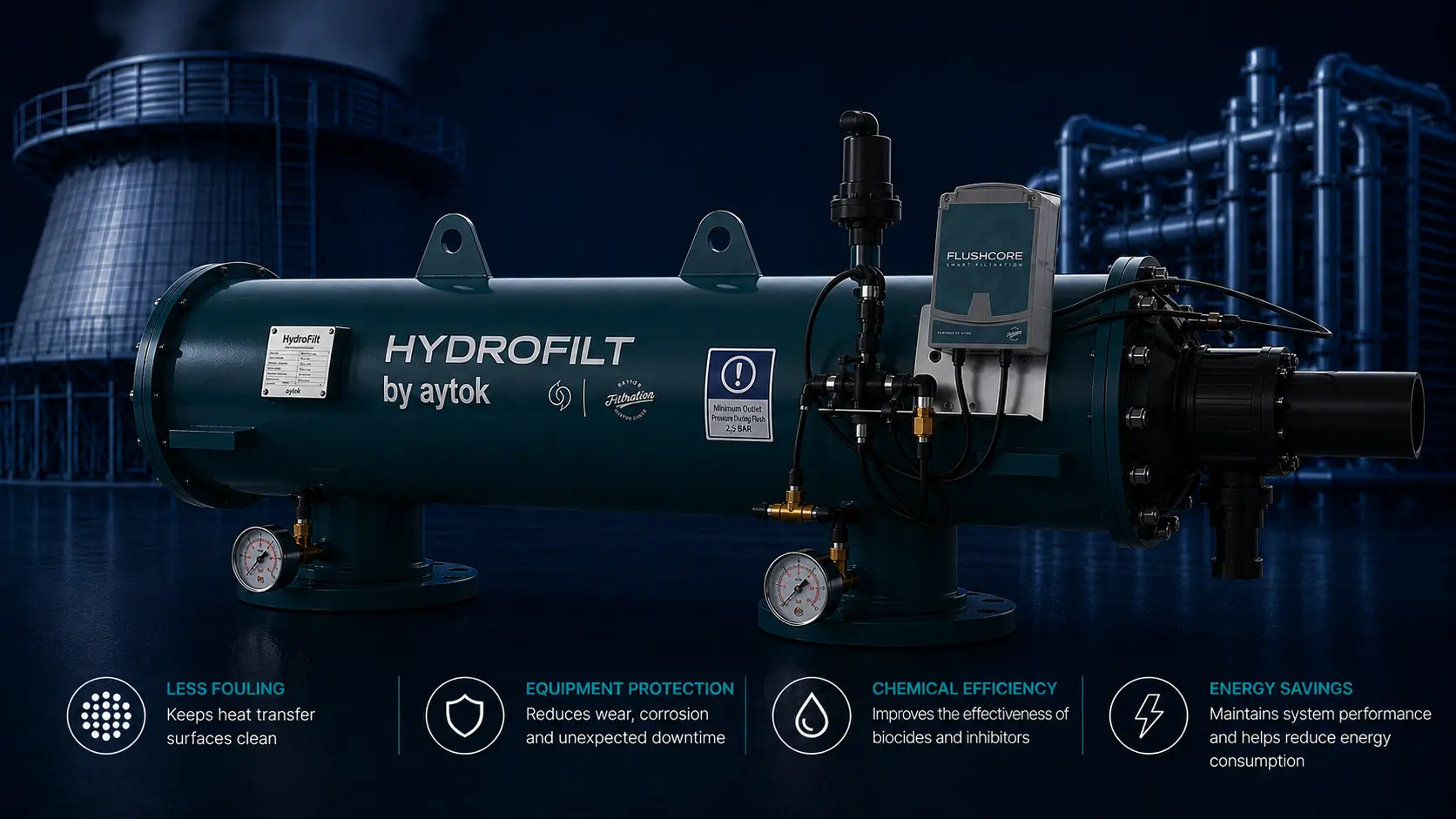
Why do suspended solids cause problems?
Even in a closed-loop system, cooling water is continuously exposed to external inputs: make-up water sources, airborne particles and the system's own wear products. Corrosion, scaling and biological growth are managed through chemical dosing; however, suspended solids cannot be removed by this method and accumulate over time.
Suspended solids circulating in cooling circuits can accumulate over time on pipe internal surfaces and heat transfer surfaces, leading to fouling. The fouling layer creates additional thermal resistance and reduces the system's Overall Heat Transfer Coefficient (U). As a result, pumps and cooling equipment may need to run for longer or at a higher load to achieve the same cooling performance.
For this reason, appropriate filtration:
- Helps keep heat transfer surfaces cleaner.
- Helps reduce the rate of fouling formation.
- Can support longer intervals between maintenance and cleaning.
- Helps the cooling system maintain its design performance for longer.
- Can contribute to preventing an increase in energy consumption.
Note: The performance improvement achieved will vary depending on water quality, particle concentration, particle type, flow velocity, operating temperature and equipment design.
A higher suspended solid load can reduce the effectiveness of biocides and corrosion inhibitors; greater chemical consumption may be required to achieve the same result.
Clogged nozzles, fouled basins and unplanned shutdowns are cost items that can largely be reduced through filtration.
Abrasive particles can accelerate wear on high-value equipment such as pumps, valves and heat exchangers.
In critical applications, maintaining water quality within a defined range helps reduce the risk of unplanned shutdowns.
Why does water loss occur and why is filtration important at this point?
Water is inevitably lost during the cooling process. The water used to replenish these losses may contain varying quantities of suspended solids and dissolved matter depending on its source and any pre-treatment applied.
Evaporation
Occurs naturally during the cooling process; the largest source of water loss.
Blowdown / Bleed
Water is discharged from the system to maintain salinity and particle concentration within acceptable limits.
Drift
Small quantities of water droplets may be carried from the tower environment; limited compared to evaporation and blowdown.
Overflow / Leakage
Basin overflows and leaks; preventable loss sources with regular maintenance.
Where you filter is as important as how much you filter
There are four key application approaches in cooling systems. Which is appropriate depends on flow rate, contamination load, existing infrastructure and operational priorities. In some cases, more than one approach is applied in combination.
A portion of the total circulation flow is passed through an independent circuit. Operates without interrupting the production line and progressively reduces total suspended solid load. The 5–10% range is a practical starting point for pre-selection; the actual rate is determined by engineering assessment based on water analysis, TSS load, basin volume and operating conditions.
A system installed at the pump discharge continuously filters the entire circulating water volume. Can be considered in processes requiring high precision or in open circuits with elevated contamination risk; equipment size and capital investment increase accordingly.
Supports controlling the entry of sediment and particles from the source into the system from the outset when replenishing system losses. The quality of the make-up water source determines the filtration requirement at this point.
Keeps sediment and sludge accumulated at the basin floor continuously in circuit. A stand-alone approach that complements side-stream filtration in systems with high sedimentation rates.
The right technology is selected according to contaminant profile
In cooling water filtration, there is no single "right technology". When the physical and chemical characteristics of the particle, water source, flow rate and operating conditions are evaluated together, the appropriate technology — or combination — becomes clear.
For mixed organic and inorganic loads
Constructed from a stack of grooved discs compressed under pressure. As water passes through the channels between the discs, particles are retained both on the surface and in depth — this dual-stage mechanism covers a broader particle profile compared to surface-only filtration technologies.
Polymeric material options suitable for corrosive and aggressive water conditions are available. Air-assisted automatic backwash keeps water consumption low and ensures continuous filtration.
In systems where organic matter (algae, biofilm precursor particles) and inorganic sediment are present together; in corrosive environments; in applications where low backwash water consumption is a priority.
For high-flow, inorganic particle loads
Particles are retained as water passes through a stainless steel screen/mesh surface. When gradual build-up reaches a defined differential pressure, automatic backwash is triggered. High flow capacity per unit and a small footprint are the primary advantages.
Better suited to systems with a predominantly inorganic contaminant profile and low fibrous or organic particle content; backwash frequency may increase when organic load is high.
When high flow rates must be handled in a limited space; when the contaminant profile consists predominantly of inorganic or mineral particles.
For fine sediment and turbidity control
Water passes through a filter bed consisting of sand, gravel, crushed glass or various material combinations. Particles are retained distributed throughout the depth of the bed — this in-depth filtration mechanism is effective for low-density and fine-grained particles.
Different media and bed configurations can be selected according to the filtration characteristics required by the application. Backwash water consumption and equipment footprint are parameters to be assessed during the sizing phase.
When fine sediment originating from make-up water sources needs to be controlled; in applications where in-depth retention of turbidity and low-density particles is the priority.
For pre-separation of heavy and dense particles
This technology has no moving parts and uses centrifugal force to separate solids with a higher specific gravity than water. It has a very small footprint and low operating cost.
It does not retain organic particles or low-density particulates; for this reason it is generally not sufficient as a standalone solution. It is used as a pre-separation stage in systems requiring fine filtration downstream.
In systems with a high load of sand and heavy mineral particles, as a pre-separation stage; or when a staged system is to be configured in combination with disc or screen filtration.
Side-stream flow rate — for initial capacity estimation
Enter the total circulation flow rate; see the approximate filtration flow rate based on the 5–10% side-stream ratio, which is a practical starting point for pre-selection. This value is not a precise engineering calculation.
Core challenges in cooling water systems
Filtration does not resolve these four challenges in isolation; however, by reducing the suspended solid load that accelerates their formation, it can contribute to more effective chemical control programmes.
Fouling
Accumulation of dust, dirt and sediment on pipe and heat transfer surfaces increases thermal resistance and may require more energy for equipment to maintain design performance. Reducing particle load can help limit the rate of this accumulation.
Biological Growth
High temperature and humidity can create favourable conditions for certain bacteria. Surface deposits and sediment can provide suitable substrate for these microorganisms. Biological control is primarily managed through the chemical programme; filtration can support this programme by reducing particle load.
Scaling
Loss of solubility of certain salts at elevated temperatures, resulting in deposition on heat transfer surfaces, can increase thermal resistance. Primarily managed through chemical conditioning (inhibitors, pH control); filtration can indirectly contribute to the effectiveness of the chemical programme.
Corrosion
Uncontrolled chemical balance, dissolved gases and abrasive particles can accelerate degradation of metal surfaces. Corrosion control is managed through chemical programme and material selection; reducing suspended solids can support these programmes.
Questions to be clarified for an accurate proposal
Check the items below for your system to see which data should be ready before a technical assessment.
Filtration Point
Side-stream, full-stream, make-up water or basin cleaning — or a combination?
Basin / Sump Volume
What is the total water volume of the cooling tower basin?
Make-up Water Source
Is mains, well or surface water being used?
Flow Rate and Pressure
What is the system's nominal flow rate? Is the pressure steady or variable?
TSS / Turbidity
Are current suspended solid or turbidity values being measured?
Contaminant Type
Sand, algae, organic matter — or a mixed load?
Footprint
How much space is available for the filtration unit on site?
Backwash Discharge
Where and how will backwash water be discharged?
Priority
Energy, maintenance, chemical reduction or process reliability — which is the main driver?
Total Cost of Ownership
Have purchase, maintenance, backwash and energy costs been evaluated together?
Correct filtration means proper system sizing, not just selecting a filter type
Aytok Filtre offers disc filters, automatic screen filters, media filters and hydrocyclones under one roof for cooling tower, process water and heat exchanger protection applications. Solutions are sized not only by filter type, but according to water source, particle characteristics, flow-pressure conditions and operational objectives.
Modular systems that can be integrated into existing cooling circuits without interrupting the production process.
Self-cleaning systems with low water consumption that provide continuous filtration.
Determining filtration grade and equipment capacity based on water analysis and flow data.
Aytok Filtre exports to more than 90 countries from its manufacturing base in Konya, Türkiye.
Field Case Studies
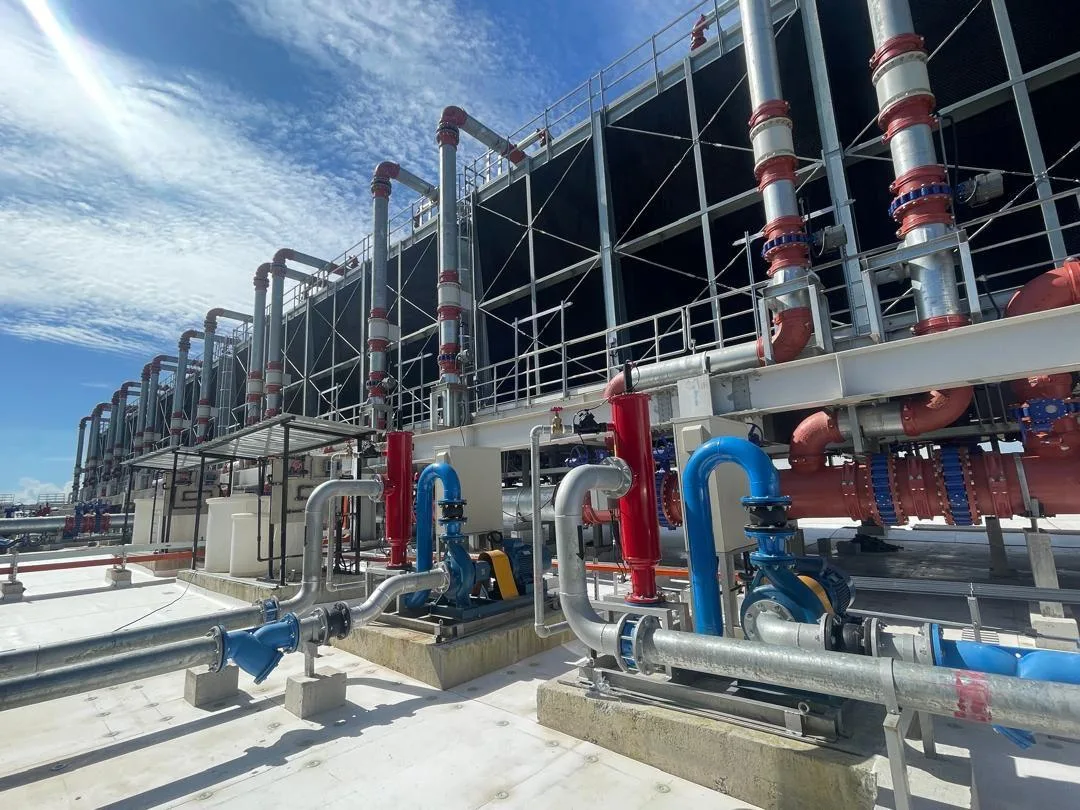
Hyperscale Data Center Advanced Cooling Water Filtration
Aytok delivers high-performance automatic self-cleaning filtration systems for a 128,000 m² hyperscale data center in Johor, Malaysia. Designed for mission-critical infrastructure, our solutions protect cooling water circuits by effectively removing suspended solids. Our solutions ensure peak cooling efficiency, minimize unplanned downtime, and extend the lifespan of industrial equipment. This project sets a benchmark for sustainable water management and operational reliability in large-scale digital infrastructure.

Advanced Automatic Disc Filtration for Industrial Cooling Systems
Aytok delivers a robust automatic disc filtration system for a major industrial cooling project in the United Arab Emirates (UAE). Engineered to provide 50-micron precision at a flow rate of 720 m³/hr, this system serves as the ultimate line of defense for critical infrastructure. By effectively removing contaminants from industrial cooling water, the system ensures peak thermal efficiency and protects downstream equipment from fouling. This project highlights our commitment to sustainable industrial water management and operational reliability in the Middle East's demanding environments.
Let us identify the right cooling tower filter solution for your system
By evaluating your flow rate, water analysis and operating conditions, we can recommend the most suitable cooling tower filter technology, installation point and filtration capacity for your system.