
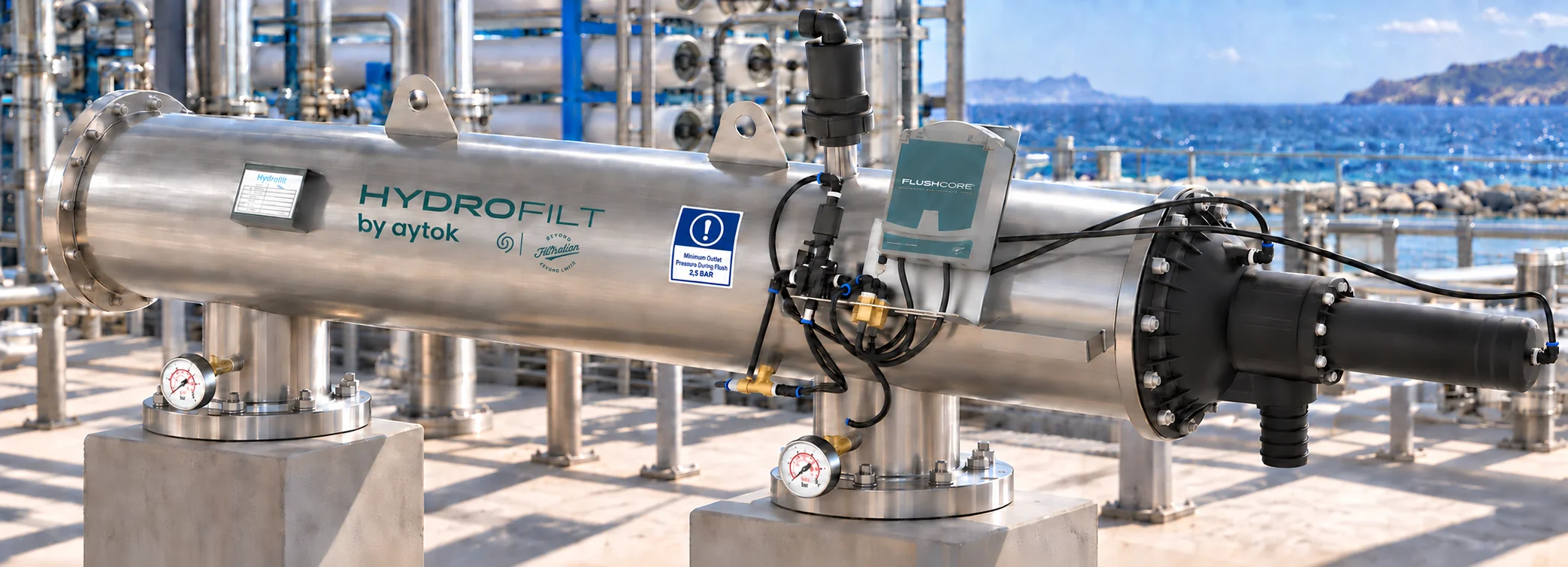
Reliable SWRO operation starts with effective pretreatment
SWRO is usually discussed in terms of membrane performance, operating pressure and salt rejection. Yet how steadily the train operates also depends on how the seawater is conditioned before it reaches the membranes.
An intake can carry sand, silt, suspended organic matter and small shell fragments into the plant. This load is not constant: it shifts with tides, storms, seasonal algal growth and activity around the intake. A pretreatment system designed around a single "typical" sample may face a very different particle load in operation.
The engineering question goes beyond "what filtration rating is required?" to "what must this filter protect, under which seawater conditions, and within what hydraulic design limits?"
Controls a defined particle load
- Captures suspended particles according to the selected filtration rating
- Protects pumps, valves and the next treatment stage
- Helps keep the next stage within its operating conditions
- Maintains flow while cleaning
Functions that belong to other stages
- Salt removal: the role of the RO stage
- Control of colloids and dissolved organic matter: the relevant pretreatment stages
- Management of biological activity: the relevant pretreatment and chemical conditioning steps
- Achieving a Silt Density Index (SDI) target on its own
The intake type defines the load the filter will face
Filters operating at the same flow rate and filtration rating can perform very differently at different intake locations. Selection starts with understanding the character of the particles that will reach the filter.
Variable, organic and fibrous load
Water drawn directly from the sea through an intake pipe or channel can carry algal fragments, organic matter and small shell fragments that pass the coarse screens. During storms and algal seasons, the load can rise quickly.
Algal blooms do not only increase the particle load that a screen can capture; colloidal matter and dissolved organic compounds can also challenge downstream treatment stages. An automatic screen filter manages the particles its selected filtration rating can retain. Controlling smaller or dissolved loads is the role of other pretreatment stages, defined according to raw water characteristics.
- Critical for the filter
- Cleaning frequency at peak load, whether the cleaning cycle keeps pace with the load, and how intake chlorination affects the filter.
More stable, mineral-dominated load
Water filtered naturally through the ground usually carries a lower organic load, but sand and fine mineral particles can still reach the line. Well performance can change over time.
- Critical for the filter
- The effect of abrasive particles on the screen element and cleaning components, and whether an additional separation stage is needed upstream of the filter when the sand load is high.
Where automatic screen filters fit in an SWRO train
A simplified SWRO train consists of intake and coarse screening, automatic pre-filtration, UF or conventional pretreatment, final safety filtration with cartridge filters, and the high-pressure pump and RO membranes. The main roles of an automatic screen filter are post-intake protection and protection upstream of UF. The actual sequence depends on the intake design, raw water quality and equipment suppliers' requirements. Select a possible location to see its function.
The dashed frames (A and B) are alternative locations for an automatic screen filter, selected according to the project: A sits after coarse screening and ahead of the equipment it protects; B sits immediately upstream of UF or multimedia filtration. Depending on the project, one or, in a suitable design, both may be used. The diagram is not a mandatory plant layout; the actual process sequence varies by project.
These duties of an automatic screen filter do not mean it replaces final safety filtration ahead of RO; the final stage is designed according to the requirements of the relevant membrane supplier.
Depending on raw water quality, the pretreatment train may include additional stages such as coagulation–flocculation and dissolved air flotation (DAF). Particularly under high algal loads, these steps are evaluated upstream of UF or multimedia filtration. The location and filtration rating of the automatic screen filter should be considered together with these stages.
Post-intake protection: managing the incoming load
Coarse screens capture large debris, while sand, organic matter, small shell fragments and suspended particles that pass them travel on through the plant. An automatic screen filter at this point helps protect downstream pumps, valves and instrumentation, as well as the next pretreatment stage, from this load. Pumps installed upstream of the filter are outside the scope of this protection.
The real design test is not the average day but the high-load event: how quickly differential pressure rises, whether cleaning keeps pace, and whether enough flow remains available for the downstream process in the meantime.
What to evaluate
- Peak loads during storms, algal blooms and seasonal periods
- Cleaning frequency and cleaning water volume at peak load
- Pressure and drainage capacity required for cleaning
- Redundancy during cleaning, maintenance or failure
- Chlorine exposure of the filter if the intake is chlorinated
Upstream of UF or multimedia filtration: protecting the next stage
Some UF systems come with an integrated pre-filter; external pre-filtration may be required depending on the UF supplier's specification. Where it is required, an automatic screen filter can take on this protective step, keeping larger particles out of the membrane modules and cleaning itself based on differential pressure or a time setting.
In conventional trains with multimedia filters (MMF), the aim is the same: to limit the particle load reaching the filter bed. The filtration rating is selected not from a universal micron figure, but from the downstream supplier's requirement and the actual particle profile.
What to evaluate
- Whether the UF system has an integrated pre-filter, and the supplier's requirement for external pre-filtration
- Effect of filter pressure loss on the feed pump and UF feed pressure
- Flow variations caused by UF backwash cycles
- Effect of filter cleaning water on the plant's water balance
- How the stage behaves when raw water conditions change
A filtration rating is only the starting point
Two filters with the same filtration rating can behave differently in the field. Effective screen area, element construction, flow distribution and the cleaning mechanism determine the differential pressure and how the filter responds as particles accumulate. Selection is made with five interconnected variables in view.
Particle profile and load
Which particles are present, and how do their concentrations change under adverse conditions? Average turbidity alone does not capture peak loading conditions.
Flow and available pressure
What flow must the unit handle, and how much pressure loss can the next stage accept?
Filtration area and loading
Is the effective screen area suitable for the required flow and the expected rate of solids accumulation?
Cleaning conditions
Is there enough pressure and a suitable drain arrangement for reliable cleaning at the installation point?
Continuity and redundancy
What happens to the train while a unit is cleaning, isolated or under maintenance?
The goal is a stable process, not the smallest number
A filtration rating finer than necessary can raise cleaning demand and pressure loss without improving the train's performance. A filtration rating that is too coarse leaves the protected equipment exposed.
The cleaning cycle is part of the design
As particles accumulate on the screen surface, differential pressure (ΔP) rises. When the set threshold or time setting is reached, automatic cleaning starts, the element is cleaned and filtration continues. The diagram below shows qualitatively how this cycle looks under different operating conditions.
This is a qualitative illustration; the axes do not represent measured values from a real plant.
For this reason, the control system should let operators monitor trends in differential pressure and cleaning frequency. A persistent rise in either may indicate a change in intake water or a problem elsewhere in the pretreatment train.
Seawater changes the material decision too
Filtration performance is only one part of the design. Seawater and coastal environments bring corrosion risks that affect the entire assembly, not just the pressure vessel.
For automatic screen filters in desalination pre-filtration applications, Aytok offers SS316L stainless steel as a material option. SS316L does not provide unconditional corrosion resistance in seawater, particularly in crevices and stagnant zones; its suitability is verified against water chemistry and operating conditions.
The final configuration is approved after this verification. The body, screen element, internal cleaning components, seals and fasteners may face different exposures, so each is reviewed separately. A complete list of construction materials and the site conditions are considered together before the configuration is approved.
Body
The pressure-bearing body is in constant contact with seawater and, in coastal settings, is also exposed on its outer surface.
- Exposure of the internal surface during operation and shutdown
- Weld zones and surface treatments
- Salt-laden air exposure in outdoor installations
Screen element
This is the surface where filtration takes place; it is exposed both to seawater and to the mechanical action of the particles it retains.
- Effect of corrosion at fine openings on the filtration rating
- Mechanical effect of abrasive particles such as sand
- Mechanical loads during cleaning
Internal cleaning components
Moving parts work in a different mechanical and chemical environment from the body; reliable cleaning depends on their condition.
- Exposure of moving parts, bearing and shaft areas
- Points where dissimilar metals are in contact
- Effect of cleaning frequency on component wear
Seals and fasteners
Tight contact zones are points that require separate evaluation in seawater applications.
- Compatibility of seal materials with chlorine and temperature
- Narrow gaps at flange and bolted connections
- Condition of parts removed and refitted during maintenance
Size the filter for operating conditions, not just clean-screen flow
A filter can meet its required flow while the element is clean and still cause problems as the screen loads. In SWRO pretreatment, the critical operating picture combines the pressure available at the filter inlet, the differential pressure at which cleaning starts, the pressure needed for effective cleaning and the pressure that must remain for the next stage.
Hydraulic balance
Cleaning water and drainage capacity are included in the hydraulic balance of the train. Filter size and flow rate alone do not answer these questions.
Uninterrupted service
Where uninterrupted service is required, multiple-unit arrangements and isolation valves are configured to cover a single unit being cleaned or under maintenance.
Trend monitoring
Trends in differential pressure and cleaning frequency are early indicators of changes in intake water and problems in the train; the control system should make them visible.
Shutdown and restart
The condition of water left in the filter during shutdowns and the restart steps are defined in advance, for both material and operational reliability.
Seven questions to answer before specifying the filter
The answers show whether the project needs post-intake protection, protection upstream of UF or multimedia filtration, or both. Tick the questions you can already answer for your project.
What to share with our team
Send us the data you have; missing data is not a problem, and we can work out together what needs to be measured.
Frequently asked questions
Does an automatic screen filter remove salt or dissolved substances from seawater?
Where is an automatic screen filter installed in an SWRO train?
What material option is offered for seawater pre-filtration?
What information is needed for a technical evaluation?
Know your seawater first, then design the filter
Effective SWRO pretreatment is a sequence of defined protective duties. Share your intake water data, process flow diagram and downstream equipment requirements, and our engineering team will evaluate the appropriate filter location and function and the suitability of the SS316L material option for your project.